Every year, the anniversary of the fourtieth day (Arbaeen) of Emam
Hosseyn's martyrdom, the grandson of Prophet Mohammad, is mourned
officially throughout Iran. The city of Bushehr, an ancient port
situated on the Persian Gulf, is renowned for its mourning rituals on
this day.
Arbaeen ceremony starts officially with the sounds and
rhythmic display of seven dammams, double headed drums, one side struck
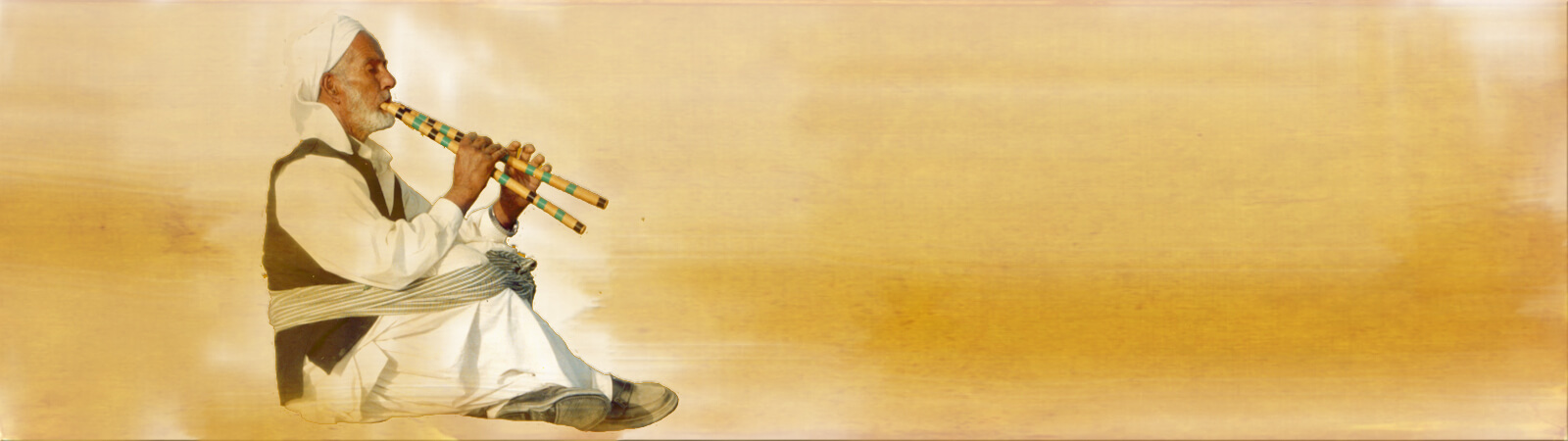
with a stick, the other with the fingers, seven cymbals and one bugh, a
wind instrument reiterating a two note motif (c-f) on a certain rhythmic
pattern. A 'Peeshkhân', literally 'one who sings before', arrives on
the scene and begins singing nohe'(s), songs with religious texts, made
up of rhymed verses of different lengths, dealing with various episodes
of the martyrdom. Meanwhile, a circle of men, young and old, begings to
form around him. Now, the principal soloist, singer of nohes, nohé khân,
who has been waiting for more circle to take shape, enters the circle
and stands in the centre while the peeshkhan leaves the scene. The
nohekhan now begins the nohés, and the refrain is taken up by the
circles; the singers of the circles have a more active and dynamic part
to play than repeating the refrains, often entering in the midst of a
hemistich and finishing the phrase, or often responding with certain
dramatic ejaculations such as "va-vey-la", meaning "o woe". The texts,
interestingly, deal mainly with Zeynab, Emam Hosseyn's sister, who
arrives from Shâm for her brother's arbaeen, and how she pours out her
sorrow with the poetic images she uses to express her terrible grief.
Her brother had been beheaded, and other members of her family cruelly
slained in the tragic battle which took place in the fields of Karbala.
...